

How to Fly with a Guinea Pig?
You are planning on traveling with guinea pigs? Classified among rodents and exotic pets, guinea pigs are subject to specific requirements that vary depending on the airline and the country of destination. What documents are required, what are the acceptance conditions and potential costs? This article covers the essential points to know to prepare your journey with your pet with complete peace of mind.
In a Nutshell
- Flying with a guinea pig is possible, but rarely in the cabin: your pet will generally need to be transported in the hold (if allowed by the airline pet policy) or by air cargo.
- To be able to fly, your guinea pig will need a health certificate from a veterinarian, an up-to-date vaccination record, and possibly an import permit depending on the destination country.
- Air travel of a guinea pig requires for your pet to be identified (by microchip or tattoo), vaccinated against rabies, and transported in an IATA-approved cage.
- The cost of transport varies according to several factors: expect from €50 for hold transport, excluding veterinary fees, pet carrier, and any administrative procedures.
Can Guinea Pigs Travel by Plane?
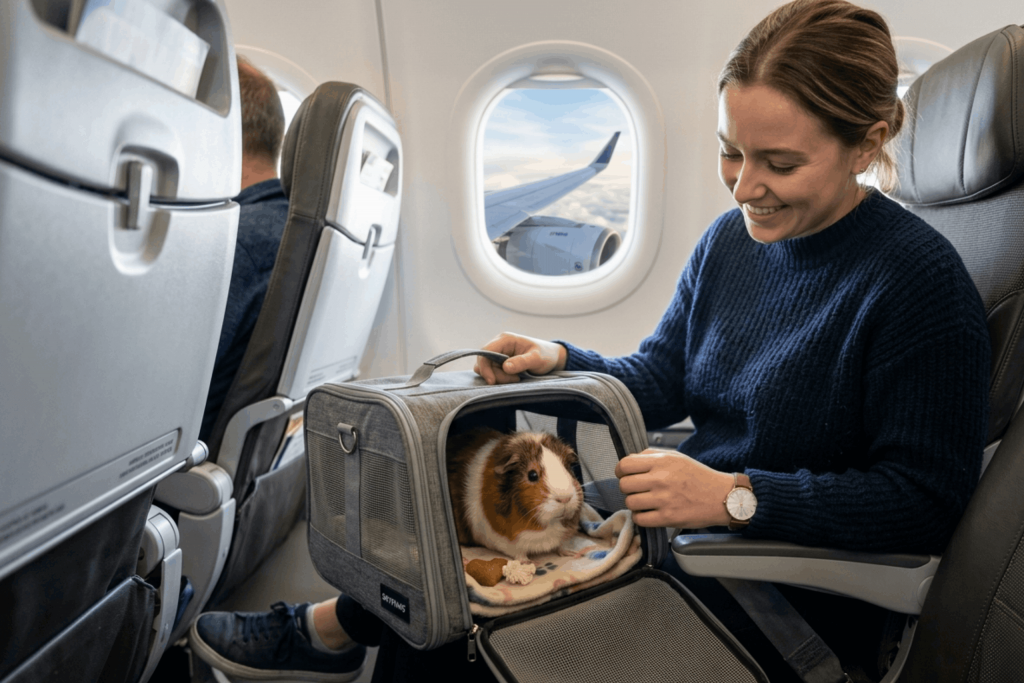
In most cases, guinea pigs are not allowed in the cabin. Unlike small dogs and cats, rodents such as the guinea pig are classified as exotic pets and are generally excluded from the passenger cabin by most airlines.
There are, however, a few exceptions depending on the carrier and the country of departure. Some airlines may accept rodents in the cabin if their total weight (animal + travel cage) does not exceed a defined threshold, and if the required dimensions are met. These cases remain rare and subject to strict conditions.
Important
It is essential to contact your airline or our team directly before making any reservation to find out the acceptance conditions applicable to your flight and destination.
How to Travel with Guinea Pigs on a Plane?
Since traveling with guinea pigs in the cabin is rarely allowed, two other options are available to transport your guinea pig by airplane: in the hold or by air cargo. Each has specific transport conditions that should be assessed based on your situation.
Option 1 – Transport as “Excess Baggage”
Your guinea pig travels in the hold, on the same flight as you, as a checked baggage. This is the most accessible option for animal transport in France or within the European Union, when the carrier accepts rodents.
Your checked pet must travel in an IATA-approved transport cage, large enough to be able to stand up, turn around, and lie down comfortably. The travel crate must also be sturdy, well-ventilated, and meet the dimensions required by the carrier.
The main advantage is that you will be able to travel on the same plane as your pet, at a generally lower cost. However, the hold can be stressful for a rodent that is sensitive to temperature, noise, and pressure variations, and not all airlines offer this option.
Option 2 – Air Cargo Transport
Air cargo is recommended for long-distance international travel, particularly to South Africa or North America (Canada, USA). The animal is entrusted to a carrier specialized in the transport of live animals, who handles all customs, administrative and sanitary formalities.
This option offers greater guarantees in terms of regulatory compliance and comfort for the animal.
What Documents Do You Need to Fly Internationally with Your Guinea Pig?
Several documents are required to transport a guinea pig by air. It is essential to gather them well in advance of departure, as some must be issued within a specific timeframe:
- An identification record for your guinea pigThe International Pet Health Certificate: certifies that your guinea pig is in good health and fit for air transport. It is issued by an accredited vet a few days before your flight.
The vaccination record: guinea pigs are not subject to mandatory rabies vaccination in all countries, but an up-to-date vaccination record may be required depending on the destination.
The import permit: certain third countries require a specific permit for the entry of a rodent on their territory. Check the import conditions with the embassy or consulate of the destination country.
Carrier-specific forms: some airlines require their own forms as part of their live animal check-in procedure. Check directly with your carrier before booking.
What Are the Requirements to Travel with a Guinea Pig?
The air travel of a guinea pig is governed by certain essential rules, including:
- Identification: some countries require that the guinea pig be identified by tattoo or pet microchip: a pet identification device replacing the traditional tattoo.
- Weight and dimensions: the total weight limits (animal + crate) and the average size of the transport crate depend on the airline. Make sure to verify these details directly with your carrier.
- Minimum age: young guinea pigs must be sufficiently developed to withstand the conditions of air travel. A veterinary opinion is recommended before any trip.
- Quarantine: in some countries, a quarantine period may be required upon arrival for rodents. It is therefore essential to check the health requirements of the destination country before booking your flight.
- Destination country: some countries completely refuse the entry of rodents on their territory. Contact the embassy or consulate of the destination country to find out the applicable import conditions.
Important
Regulations vary significantly depending on the airline, the country of departure, and the country of destination. It is imperative to check the specific conditions applicable to each flight before making any reservation.
What Are the Airlines Options for Flying with a Guinea Pig?
Airlines’ policies vary considerably when it comes to the transport of rodents. Here are some examples:
- Air France: the Air France pet transport policy generally does not allow rodents (hamsters, rabbits, guinea pigs, etc.) in the cabin or in the hold for safety reasons. Exotic pets (NAC) such as rodents are often prohibited or require specialized cargo transport.
- Air Austral: may accept exotic pets including guinea pigs by cargo, or in the hold depending on the routes offered, particularly to Indian Ocean destinations. Check the applicable conditions directly with the airline.
- Ryanair, EasyJet and most low-cost carriers refuse exotic pets and rodents. The transport of guinea pigs is generally prohibited.
Important
This list is not exhaustive and carrier policies are subject to change. Before making any reservation, contact your airline or our team directly to verify the conditions applicable to your situation.
How Much Does It Cost to Transport a Guinea Pig by Plane?
The cost for flying with guinea pigs varies depending on the airline and destination, the mode of transport, and the total weight (animal + crate), among other factors. The main costs to anticipate are:
- Hold transport (excess baggage): expect between €50 and €200 depending on the airline and destination.
- Air cargo transport: costs are calculated based on total weight, distance, and carrier. They can reach several hundred euros for international flights.
- IATA transport crate: budget between €30 and €100 depending on the model and required dimensions.
- Veterinary fees: budget between €50 and €150 for the consultation, health certificate, vaccine updates, etc.
- Administrative procedures: depending on the destination country, additional fees may apply, particularly for the import permit or customs formalities, among others.
Request a personalized quote for an accurate estimate tailored to your situation and destination.
How to Ensure a Safe Journey for Your Guinea Pig?
The guinea pig is a particularly sensitive animal. Good preparation is essential to reduce your pet’s stress and ensure a safe and comfortable flight. Here are some tips to prepare your pet for air travel:
- Familiarize your guinea pig with its transport crate: leave the crate open and accessible at home several weeks before departure. Your guinea pig will gradually get used to it and experience it as a safe space rather than a constraint.
- Adjust its diet: avoid feeding your guinea pig just before the flight to limit digestive discomfort. Provide hay and a source of hydration (water-rich vegetables such as cucumber) for long journeys.
- Pay attention to hydration: guinea pigs need water regularly. Since water bottles can empty in the crate, opt instead for fresh food that provides water naturally.
- Avoid tranquilizers: sedatives are not recommended for rodents, as they can disrupt their diet, breathing, and worsen stress at altitude. Consult your veterinarian before considering any medication.
- Set up the transport crate: add absorbent bedding, some hay, and a familiar object (toy, fabric bearing your scent) to reassure your pet. Avoid water bowls that may spill.
- Consult your veterinarian: a prior health check allows you to verify that your guinea pig is fit to travel by air, to update the required documents, and to receive recommendations tailored to its health condition.
Flying with a Guinea Pig: What You Need to Remember
You can travel with a guinea pig by plane, but it requires thorough preparation. From selecting the right airline to assembling the health documentation, choosing the right travel cage, and following the tips to reduce your pet’s stress: every step counts to ensure a smooth journey. As regulations vary greatly depending on destinations and carriers, it is essential to gather information well before making any reservation.
To be accompanied by animal transport professionals and simplify all the formalities, call on the services of Air Transport Animal. Our specialized team takes care of your guinea pig from start to finish, so that you can travel with complete peace of mind, wherever you are going in the world.